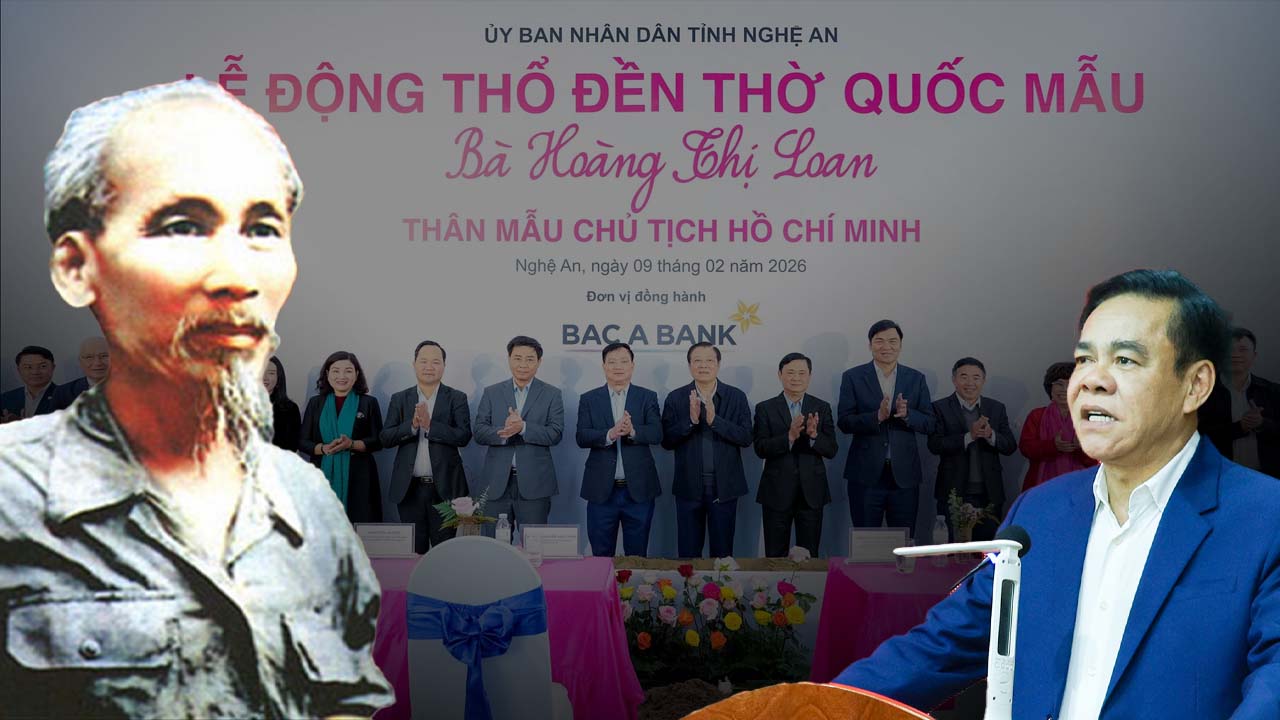
On February 9, 2026, public opinion in Vietnam was thrown into an uproar following information that Nghệ An Province held a groundbreaking ceremony to build a large-scale structure officially named: “Temple Dedicated to the National Mother Hoàng Thị Loan — the mother of President Hồ Chí Minh.”
Using the title “National Mother” to honor the woman who gave birth to Hồ Chí Minh—the leader of the revolution that overthrew the feudal monarchy—has truly become a major crisis in political thinking.
According to cultural researchers, this is an act of “normative disorder,” which not only fails to elevate her status but also directly insults the ideals and political legacy of President Hồ Chí Minh.
Vietnamese and Chinese authoritative dictionaries define “National Mother” as a title reserved exclusively for the mother of a king, meaning the Empress Dowager in a monarchical system. She is regarded as the mother of the nation in a system where power belongs to a single ruling dynasty.
Nghệ An’s provincial leadership unilaterally imposing this title on Hoàng Thị Loan is a crude and awkward grafting—turning an ordinary, hardworking Vietnamese woman into a feudal noble consort.
This creates a historical paradox that is difficult to accept: President Hồ Chí Minh devoted his entire life to leading the people to overthrow feudalism and establish the Democratic Republic. Yet his successors are now attempting to “feudalize” the Hồ Chí Minh family, pushing it toward a “Red Dynasty” orientation.
Many analysts have questioned the logic of how the Vietnamese state defines titles of power. Hồ Chí Minh has long been acclaimed by the people as the “Father of the Nation,” a title of respect.
But if Hoàng Thị Loan were granted the title “National Mother”—the shared mother of the entire country—then the symbolic national relationship between mother and son would become overlapping and profoundly contradictory.
Nghệ An’s unilateral act of “canonizing and crowning” Mr. Hồ into a position originally reserved only for mythical ancestors is an arbitrary act culturally and spiritually.
For in Vietnam’s 4,000-year history and legends—especially the tale of the “Hundred Eggs”—only Lady Âu Cơ has been uniquely venerated as the National Mother of all clans and families.
More notably, elevating Hoàng Thị Loan to “National Mother” appears to run counter to the nature of today’s Vietnamese state under the leadership of the Communist Party, which is founded on the principle that the country belongs to the people, not to any particular lineage.
By calling a member of Hồ Chí Minh’s family the National Mother, the Communist Party’s political system inadvertently admits that Vietnam belongs to a “Nguyễn Sinh” clan—a kind of disguised “Red Dynasty.”
This becomes a serious loophole that hostile forces could exploit to criticize that Vietnam is returning to feudalism after more than 80 years of national-democratic revolution.
Experts have also pointed out a naïve but extremely sensitive mistake: in the feudal era, the title “National Mother” was bestowed by the king upon his own mother. Today, however, the title is being whimsically self-bestowed upon a leader by certain “foolish” local officials.
This not only shows an abuse of power and a lack of cultural propriety, but also reveals a severe deficiency in national cultural knowledge among Nghệ An’s leadership apparatus.
A spiritual work and national symbol such as a temple dedicated to the mother of President Hồ Chí Minh cannot be based on the thinking of rogue officials who disregard rules and the law.
In the context following the 14th Party Congress, the developments in Nghệ An described above suggest that someone is trying to tarnish the simple image that President Hồ Chí Minh painstakingly built throughout his life.
Tra My – Thoibao.de