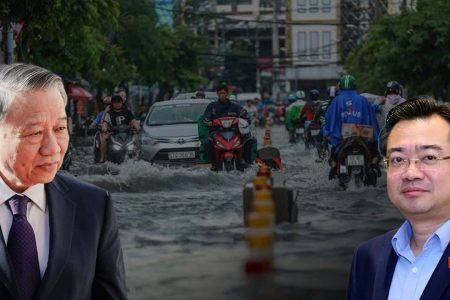
The fact that Hanoi City officially piloted a traffic reorganization on the Nhật Tân Bridge and then hastily removed the distance warning signs just three days after their installation in late September 2026 is not merely an operational mishap in urban management.
According to observers, it is a microcosm of a deep-seated ailment in the mindset governing Vietnam’s state apparatus today. That is, they erect countless barriers that stifle operations, only to hastily dismantle them later and label it a “reform initiative.”
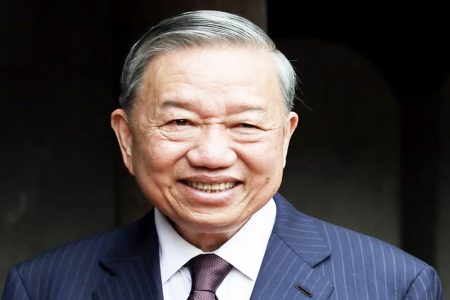
This cycle of “tying one’s own hands and then freeing oneself” is widespread at the highest levels of governance under General Secretary and President To Lam, whose ambition to achieve double-digit GDP growth is facing a fierce clash with extremely stringent market laws and an unfavorable geopolitical context.
Consequently, this ambition of Mr. To Lam and the Ba Dinh leadership is considered to be based on a scenario that lacks feasibility and is completely detached from reality.
According to economic experts, to achieve double-digit growth during the 2026–2030 period, Vietnam would need investment capital totaling 38.5 million trillion VND, equivalent to approximately 1,500 billion USD. This means that, on average, about 300 billion USD would need to be mobilized each year.
However, even under the minimum scenario recently calculated by the Ministry of Finance for 2026, the economy would still require 5.1 million trillion VND, or about 200 billion USD. Yet, as of the end of the first half of 2026, only about 1.8 million trillion VND—equivalent to 70 billion USD—had been mobilized.
According to economic experts, the fact that total state budget revenue in 2025 is projected to reach only about 100 billion USD further demonstrates that there is no way to bridge the remaining funding gap in the last three months of 2026.
Moreover, Vietnam has fallen into a trade deficit of up to 20.5 billion USD in just the first eight months of 2026.
Of this amount, more than 18 billion USD was spent on fuel imports due to the turmoil in the Strait of Hormuz. This geopolitical crisis has driven domestic gasoline and diesel prices to a record high, exceeding 28,000 VND per liter.
Meanwhile, Mr. To Lam continues to pressure the government apparatus to achieve double-digit growth at all costs, despite the comprehensive difficulties currently plaguing the country.
The root cause of this impasse also lies in a gap in management philosophy. The “jerky” nature of recent policy implementation stems from an increasing reliance on a police-state mindset in economic management, rather than on the capabilities of a genuine team of technocrats.
Meanwhile, a macroeconomy—which inherently operates like a natural flow—requires a deep understanding of market laws, investor psychology, and a stable legal environment.
An economy cannot develop sustainably if it is constantly subjected to “sudden, abrupt” measures such as: suddenly enacting strict regulations, only to suddenly issue documents lifting them, as is currently the case.
Mr. To Lam’s prioritization of a control-oriented mindset over fostering development is likened to a driver who has not yet mastered the skills but keeps stepping on the gas, pushing the economy into unnecessary risks of instability.
Businesses and citizens do not need special favors or erratic, interventionist policies. The only thing they need right now is transparency, the rule of law, and a safe business environment where resources can flow according to market principles.
If Mr. To Lam’s administration fails to break free from the mindset of police-state control, it will be impossible to substantively restore market confidence; the ambition to propel the country forward will remain nothing more than a “dream on paper,” and will always stumble in the face of the harsh realities of economic currents.
Tra My – Thoibao.de